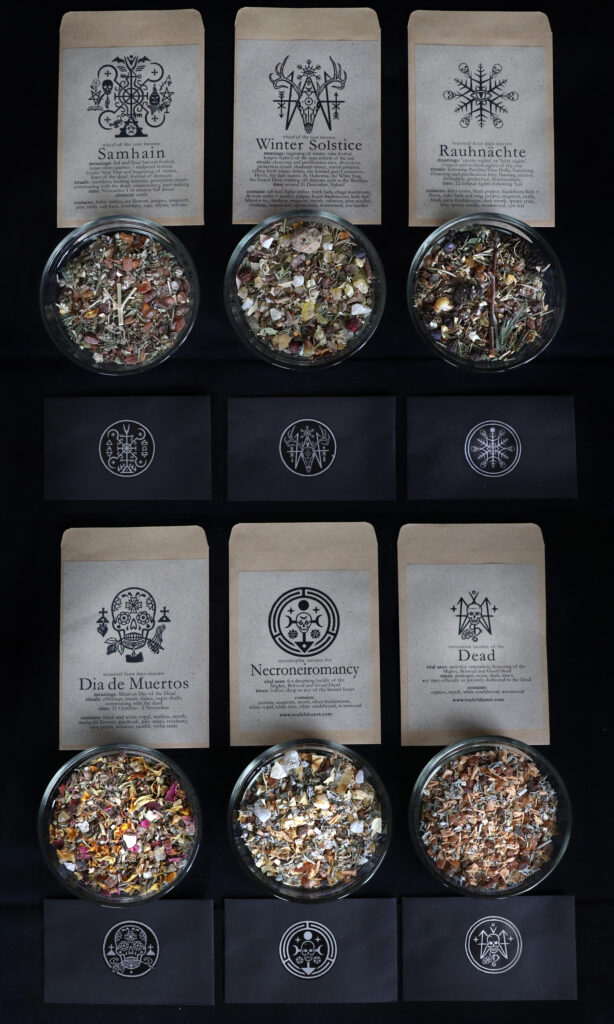
Available now: 6 blends for the dark time of the year, composed with the finest resins and herbs! Whether you plan to end the summer on Samhain with a protective and strengthening herbal blend, celebrate the joyful Day of the Dead with a wonderful frangrant copal mix, need to banish the plagues of the season, evoke the spirits of the wild and winter’s magic, talk to the Dead in dream or simply venerate them – here are the incense blends for every purpose. Try each as 20 ml samples or go all in with the 40 ml bags.
Set prices: 24 € for 6 x 20 ml black sample bag, 42 € for 6 x 40 ml large bag of each + shipping
Offer lasts until October 31st. Place order until October 18th to have incense shipped in time for Samhain!
As this year’s circle is about to come to a closure, and with Samhain approaching, I felt inspired to write a summary of my research on the wheel of the year.
The wheel of the year is based on the nature observations of our ancestors. It follows natural cycles* and fixed times, such as the solstices and equinoxes, which devide the annual circle into four quarters. Together they form a solar cross, in which the four arms mark the four seasons – spring, summer, autumn, winter (which are characteristic for Europe, as it was once covered in rainforests resulting in a relatively stable climate). This solar cross can be devided further into four lunar cross-quarter events: Imbolc, Beltane, Lughnasadh and Samhain. These in-between times were considered magical and as doorways to and for the spirits. They fall on the respective full moon of the months of February, May, August and November. For convenience today it is usually on the 1st of these months, when official celebrations of these liminal times take place. The magician may utilize both the full and the new moon, and partake in social activities on the fixed dates.
The celebrations surrounding the solstices are sometimes helt over the cause of 12 sacred nights. The Celts considered Samhain as the beginning of the new year. In Norse religion it is the dark half of the year when the motion of the annual wheel slows down and finally stands still on the winter solstice. It then takes the strength of the golden boar Gullinborsti, who by the end of the Rauhnächte slowly sets the wheel of the year into motion again.
The appearance of the sun cross in Bronze Age religions coincided with the introduction of the spoked wheel. As part of the solar chariot it replaced the solar barge. This sun wheel bears resemblance to the medicine wheel petroforms of native American people as well as the dharmachakra of Indian religions. In his books W.D. Storl refers to it as the European Medicine wheel and links it to our sylvan Celtic origins.
The first appearance of spoked wheels dates to 2000 BCE: Caucasian horsepeople, who travelled with spoked-wheel war chariots deep into the Greek peninsula, joined the mediterranean peoples living there and eventually helped form classical Greece. Celtic people enhanced the spoked wheel with an iron rim in 1000 BCE. Likely, spoked wheels were introduced to China from the West between 2000-1500 BCE.
The horse-drawn chariot, horses and wheels played a special part in Germanic and Slavic divination rituals (hippomancy). They believed their deity rode on the horse or drove the chariot and gave answer through the horses’ behaviour. For example Slavic people would let a blindfolded horse walk in a circle divided by wooden spokes or speersand it was observed whether it stepped on one. The sacred horses (often white, seldom black) were kept seperately.
Apart from being a milestone in the development of humans, the spoked wheel also has connections to deities of weaving and spinning, such as Frau Holle (Dame Hulda), who is the embodiment of an ancient omnipotent earth goddess. Her symbol is the spinning wheel, her sacred herbs and trees open up the realm to the world of the spirits all year round.
The complete wheel of the year as incense blends. Each crafted individually, inspired by the seasons, their devas and their spirits. It’s been quite a journey. As so soften, I got lost in the details, rather than quickly writing up and following a concept. The ingredients are subject to change, as my perception of the annual cycles evolves and expands. This offer includes all 8 incense blends for the wheel of the year festivals, as well 1 baneful blend for the Rauhnächte. The bags contain approximately 30 ml of each blend. Printed instructions are included. For details please read the descriptions in the single listings.
🔥REMINDER: for receiving incense in time for Lughnasadh you have to order until Monday! Any orders placed after Monday will be handled and shipped in August, when we are back from the mountains.
Tomorrow I will be packing and shipping last orders before this much needed break.
This means there is still a narrow time window to order and receive our Summer Solstice incense et al!
Summer solstice traditions are manyfold and vary regionally. They include: dancing around and jumping naked over the fire, while wearing a girdle made of mugwort, sometimes also setting a wagon wheel on fire and pushing it down a hill, burning straw figures, burning wreaths made from weeds and scattering the ashes in the garden or field, collecting healing herbs (called Johanniskräuter) and passing them through the flames of the midsummer fire to be blessed by the fire god and increase their potency, lighting mullein torches, eating elder bread, drinking psychoactive beer, searching for the male fern’s seed.
The solstices mark important turning points in the annual cycle of the earth and the sun. In myth this is reflected in the killing of Baldur (the god of light) by Loki (Lugus) or the oak king (symbolic of the sun) being defeated by the holly king (symbolic of the dark season). While these are myths, the sacrifice of elderly priest kings on the solstice might have been a real practice among pre-celtic European people.
The summer solstice celebrations last for 12 nights, similar to the 12 nights following the winter solstice. With the arrival of Christianity, the veneration of Saint John the Baptist, who according to lore was beheaded on the summer solstice, substitutet the worship of the oak king and sun god, and the solstice celebration was replaced by St. John’s day. One of the most importrant healing herbs of Europe and even fireflies were thence re-named after the saint. Likewise, the once revered Bilwis (wise men or women who protected the fields and ensured their fertility) were turned into corn demons themselves.
+ + + +
The Summer Solstice incense blend is dedicated to the rituals surrounding the summer solstice, when the sun reaches its annual zenith. The ophidian seal adorning the incense is inspired by the viper’s bugloss (Echium vulgare) herb, which is typically blooming then and is an ingredient in nine-herbs-charms.
The ingredients for this blend are the herbs and flowers traditionally associated with the summer solstice. The incense blend evokes a vision of a blooming meadow at dusk: bushes of blue flowering viper’s bugloss cover the ground and transform into serpents. Plantain, thistle and St. John’s wort grow beside it. Fireflies begin their nocturnal wedding dance. Nearby, the fragrant yellow flowers of the evening primrose glow in the evening light and emit their sweet scent into the sweltry air, attracting the most wondrous kind of fairy folk, and their flowerheads turn into scaled dragons…
Use this blend for divination, purification and letting go of the old, for protection, renewal, celebrating the night, inspired dreaming and creativity. The blend can also aid in decision making and gaining deeper wisdom: cast out the serpent as a symbol of “evil” or embrace it as a bringer of wisdom and become a serpent yourself. The solsice is also a good occasion for consecrating a magical weapon, as well as exploring new systems of magic…
This blend for the winter solstice smells like a walk through the winter forest – resinous, coniferous and aerial. It contains a number of precious resins such as high grade Hojari frankincense, sandarak resin, spruce resin and baltic amber. White birch bark and chaga mushroom evoke the self-restoring powers of nature, ash leaf, metasequoia and yew needles bring forth the circling life energies of above and below, holly, juniper, mistletoe and wormwood call forth the protective spirits, mugwort and labrador tea open the third eye. Oakmoss, resinous white fir cone scales, pine, fire and spruce needles all add up to an evergreen winter blend, perfect for lighting up and guiding through the twelve longest nights of the year.
Small acts may still bring small changes and, most importantly, some rest and recreational time. Hence, whether you are able to make a great ritual bonfire or only light a candle, it still does make a difference! My solstice ritual was very basic and reduced. I have cut it down to burning incense and (re-)charging gemstones, which I find at random and in color and vibe connect to the beginning of winter. These currently being a dark translucent black-green tourmaline, a nicely banded gray blueish hawk’s eye, some clear irisdescent quartz crystals, a new rock crystal with dark green inclusions and an ice blue topaz with golden inclusions, which shows some subtle light diffracting effects.
The longest night here was stormy and lit up by lightning. Germany is experiencing heavy storms until christmas. We got a taste of it the next day, when we went outside with the kids for some jolly carousel rides in the rain! It is no wonder our ancestors connected this time of the year with the wild hunt! Though it marks also the turning point for the return of light. But the way is still long and winter has just officially begun.
I used the liminality of the occasion to (re-)charge said stones in the smoke of my Winter Solstice incense blend. And the moment I placed it on the burning coal and the blueish smoke rose up and followed the wind, I realised again that it is indeed one of my favorites! I was also happy to hear back from people, who also use(d) this blend. It feels actually really great knowing that people in very different places burn the same incense and appreciate its effects.
I therefore wish all my customers and followers a truly magical winter time!
Here comes a another fresh batch of Samhain incense! This blend is was the first I created for the harvest festivals and closes the circle, being dedicated to the third and final harvest feast. At the same time it marks the beginning of the Gaelic New Year. On Samhain the living and the dead assemble and sacrifices are made. The blend is hence both protective and strengthening as well as suited for opening the gates to the spirit world and chthonic realms. It smells woody, herbaceaous and resinous.
Contains: amber, juniper, mugwort, pine + spruce resin from local forests, oak bark, rosemary, sage, thyme, vervain
Please remember my ordering deadlines for Samhain: 18 Oct. ’23 for international shipments 25 Oct. ’23 for orders within Germany
This incense blend is dedicated to seasonal feast day of Mabon, September feast days and the Autumn equinox in particular. It is part of the Teufelskunst “wheel of the year” incense series and is dedicated to the second of the harvest festivals (the first being Lughnasadh and the third being Samhain). It is all about the rituals of autumn, for example the celebration of the Autumn Equinox and blot rituals / harvest blessing and sacrificial rituals. It smells earthy, warm and sweet, but also resinous. It unifies dark and light aspects. It contains aromatic and warming ingredients, such as cinnamon, coriander, nutmeg, precious saffron, storax bark and vetiver root. The resins in this fiery blend are powerful protective agents, such as dragon’s blood, dark copal and pine resin. Sweet myrrh, oakmoss and sticky labdanum in turn revere the scents of autumn and bind the herbs. Fragrant herbs such as mugwort and mullein complete this special composition. Lastly, freshly gathered nettle is included as a reference to the goddesses of spinning and weaving, but also enhances the protective qualities of this magical Mabon blend.
The sigil adorning the blend has been desgined especially for Mabon (read more in my next post).
I made new designs for them, especially for the qliphotic blends. Step by step I am also re-doing the feast day sigils. It’s a pile of work, but ultimately it will be easier to simply print and fill these than cleansing, labeling and packing up glass jars, which also always meant more packing waste. Also, the production of the silver foil labels wasn’t particularly environmental friendly either. So…
These are meant to be smelled and burnt.
I may still do special editions in glass jars every once in a blue moon. I have in fact been gifted a big pile of small miron violet glass jars…
But for now, it’s paper bags! How do you like them?